Skip to content
A health plan can use AI to flag a claims exception in seconds. Resolving it takes longer. Someone must check eligibility, retrieve authorization records, interpret benefit rules and update information across several systems. That gap between spotting a problem and closing it is where agentic AI in healthcare payer operations is starting to matter.
AI in health insurance is already widespread. In May 2025, the National Association of Insurance Commissioners (NAIC) reported that 84% of health insurers responding to its AI/ML survey currently use it, in areas that include utilization management, prior authorization and fraud detection. As algorithmic decision-making expands, even a minor execution error in claims exception handling can ripple downstream and disrupt member care and provider relationships.
Most of that AI generates insight. Unlike traditional AI platforms and tools, which are designed mainly to produce answers or predict outcomes, AI agents can coordinate multiple steps toward a defined objective, use connected applications and take actions within established permissions. For payers, that moves automation from passive insight generation to active workflow orchestration.
As 2027 approaches, health plans need to know which administrative responsibilities can be delegated reliably to AI agents, how those actions should be governed, and what infrastructure supports them. This guide gives a verdict for five use cases, a framework for setting autonomy, the reasons pilots stall, the metrics that matter, and what to look for in an agentic AI platform.
What is agentic AI in payer operations?
Agentic AI in payer operations coordinates several administrative steps toward a defined goal, such as resolving a claim exception or an eligibility mismatch. Within set permissions, these AI agents retrieve information from connected systems, investigate records, recommend the next step, and either act or escalate the case for human review.
Healthcare AI agents are software systems that perceive information and reason across the data they can access. Rather than only responding to a prompt, they pursue a predefined objective through a sequence of actions. In payer operations that typically means retrieving information from administrative systems, examining transaction records, identifying and recommending the next best step, and carrying out permitted actions or escalating.
Take an enrollment discrepancy. A conventional automation will flag that eligibility information in two systems does not match. An AI agent with the necessary access and permissions can investigate the conflicting records, identify the likely source of the discrepancy, request missing information, and prepare or execute an authorized correction.
Agentic AI vs RPA, predictive AI, and generative AI
The distinction becomes clearer when agentic AI is placed next to the technologies health plans already use in administration.
| Technology | Primary function | Applicability for payers |
|---|---|---|
| Robotic Process Automation (RPA) | Executes predefined rules and repetitive steps | Moving data between systems or processing standardized updates |
| Predictive AI | Estimates probabilities, risks, or likely outcomes | Identifying potentially anomalous claims |
| Generative AI | Interprets and generates content | Summarizing documents or answering policy-related questions |
| Agentic AI | Coordinates actions toward a defined objective | Investigating an exception, gathering evidence, and initiating permitted workflow steps |
These technologies are not mutually exclusive. An agent may use a predictive model to spot a potential issue, or generative AI to interpret supporting documents. What sets the agentic approach apart is that it coordinates those capabilities across a workflow and adapts its next step to what it finds. That matters in payer administration, where routine transactions often turn into exceptions, cross-system dependencies keep growing, and information sits across several disconnected legacy applications. Traditional healthcare claims automation handles the claims that follow the standard path. Agents are aimed at the exceptions that fall out of it.
5 high-impact agentic AI use cases for health plans in 2027
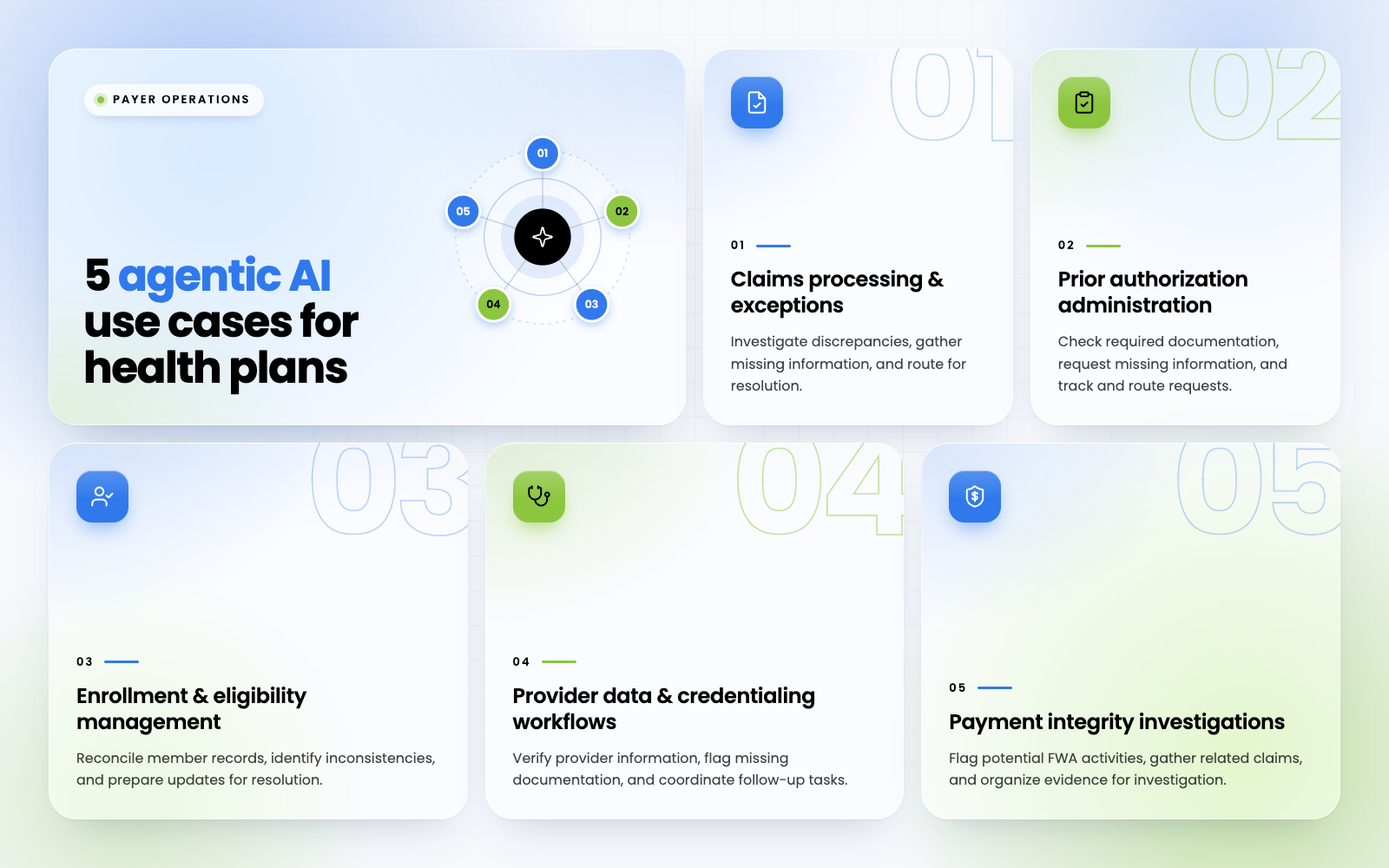
The most credible applicability of agentic AI is being increasingly experienced in workflows where information must be gathered, compared, interpreted, and acted upon across numerous administrative steps. So, where can health plans deploy AI agents today to capture immediate operational ROI?
1. Claims processing and claims automation: exception resolution
Claims administration is more than checking whether a submitted claim meets predefined rules. Exceptions arise from eligibility inconsistencies, missing or unapproved authorizations, conflicting or inaccurate provider information, and discrepancies between the claim and the benefit configuration. An AI agent can manage these exceptions by retrieving relevant records, comparing transaction details, identifying missing information and preparing a case for resolution. Where controls exist, it may also complete certain administrative corrections without requiring a user to move between several applications.
For example, an agent reviewing a pending claim might find that the procedure code billed does not match the authorization on file. It can gather the supporting evidence and route the case for review and correction under the payer's established procedures. The opportunity is to cut the time staff spend collecting information before they can address the underlying issue. Final adjudication and payment decisions must stay subject to the payer's rules, controls and approval requirements.
See how the CAPS workspace in HealthOS runs core administrative processing for health plans, and read more about agentic AI in healthcare claims and autonomous workflows.
2. AI prior authorization administration and status tracking
Prior authorization sits at the center of care delivery because it combines documentation requirements, clinical review, communication between organizations and strict timelines. AI prior authorization tools can support the administrative side: checking that required documentation is present, requesting missing information, monitoring request status and routing cases to the right review team.
These capabilities matter more as payers adapt to the CMS Interoperability and Prior Authorization Final Rule (CMS-0057-F). It applies to Medicare Advantage organizations, state Medicaid and CHIP fee-for-service programs, Medicaid managed care plans, CHIP managed care entities and Qualified Health Plan issuers on the federally-facilitated exchanges. Most of these payers must decide expedited requests within 72 hours and standard requests within seven calendar days, with compliance dates starting January 1, 2026, and must give a specific reason when a request is denied. Prior Authorization, Provider Access and Payer-to-Payer APIs must be in place by January 1, 2027. The rule does not mention agentic AI. Its emphasis on timely decisions, transparency, and electronic information exchange does reinforce the need for processes that move information efficiently and keep a clear record of what happened.
There is also a hard limit on autonomy. California's Physicians Make Decisions Act (SB 1120), effective January 1, 2025, mandates that claims denied on the basis of medical necessity be reviewed and decided by a licensed physician or qualified provider. The Act puts a necessary check on healthcare insurers using AI to decide on healthcare providers' requests to offer medical services. Agents can prepare the case but only a clinician decides on the necessity of the services rendered.
3. Enrollment and eligibility management
Enrollment information can change through new coverage, terminations, dependent updates, eligibility adjustments, and retroactive corrections. When those changes are not consistently reflected across systems, the consequences may surface later as claims rejections, billing disputes, or member service issues.
An AI agent could compare incoming enrollment transactions with existing member records, investigate inconsistencies, and determine whether additional verification is necessary.
For instance, an enrollment update may indicate that coverage has terminated while another system still shows the member as active. Rather than merely flagging the mismatch, an agent could retrieve the relevant transaction history, examine effective dates, and prepare the discrepancy for resolution.
This does not eliminate the need for eligibility rules or authorized coverage decisions. It can, however, reduce the administrative effort required to establish which records need attention and why. Learn how the Enrollment workspace connects eligibility and onboarding.
4. Provider data and credentialing workflows
Provider information is maintained across directories, contracting systems, credentialing platforms, and claims administration applications. Inconsistencies between these records can create downstream operational problems.
Agentic AI streamlines provider credentialing by cross-referencing national registries, flagging missing documentation, checking verification status, and coordinating follow-up tasks. An agent is capable of detecting conflicting practice addresses across systems, examining available source records, and preparing a proposed update with supporting evidence. Credentialing approvals, contracting decisions, and other consequential actions would still continue to require obtaining the necessary verifications and authorizations. See the Provider workspace.
5. Payment integrity investigations
Payment integrity strategies are devised to prevent improper payments, investigate unusual patterns, and determine whether further action is warranted. An effective payment integrity program can deploy AI agents to flag potential fraud, waste, and abuse (FWA) activities by examining the medical codes contained in claims and matching them with the services rendered, gathering claim histories, reviewing relevant policy information, identifying related transactions, and organizing evidence for investigation.
However, what's important for these agents is to understand the distinction between detecting an anomaly and establishing an improper payment. An unusual billing pattern, for instance, does not automatically indicate FWA. Agentic AI may accelerate the investigative process, but payment interventions, recoveries, and other consequential actions should remain governed by validated rules, appropriate evidence, and established review procedures, further supported by keeping humans in the loop. The benefit here is not unbridled automation — it is the ability of AI agents to coordinate information and actions that would otherwise require repeated manual intervention. The Sentinel workspace is built for this work.
How much autonomy should AI agents have?
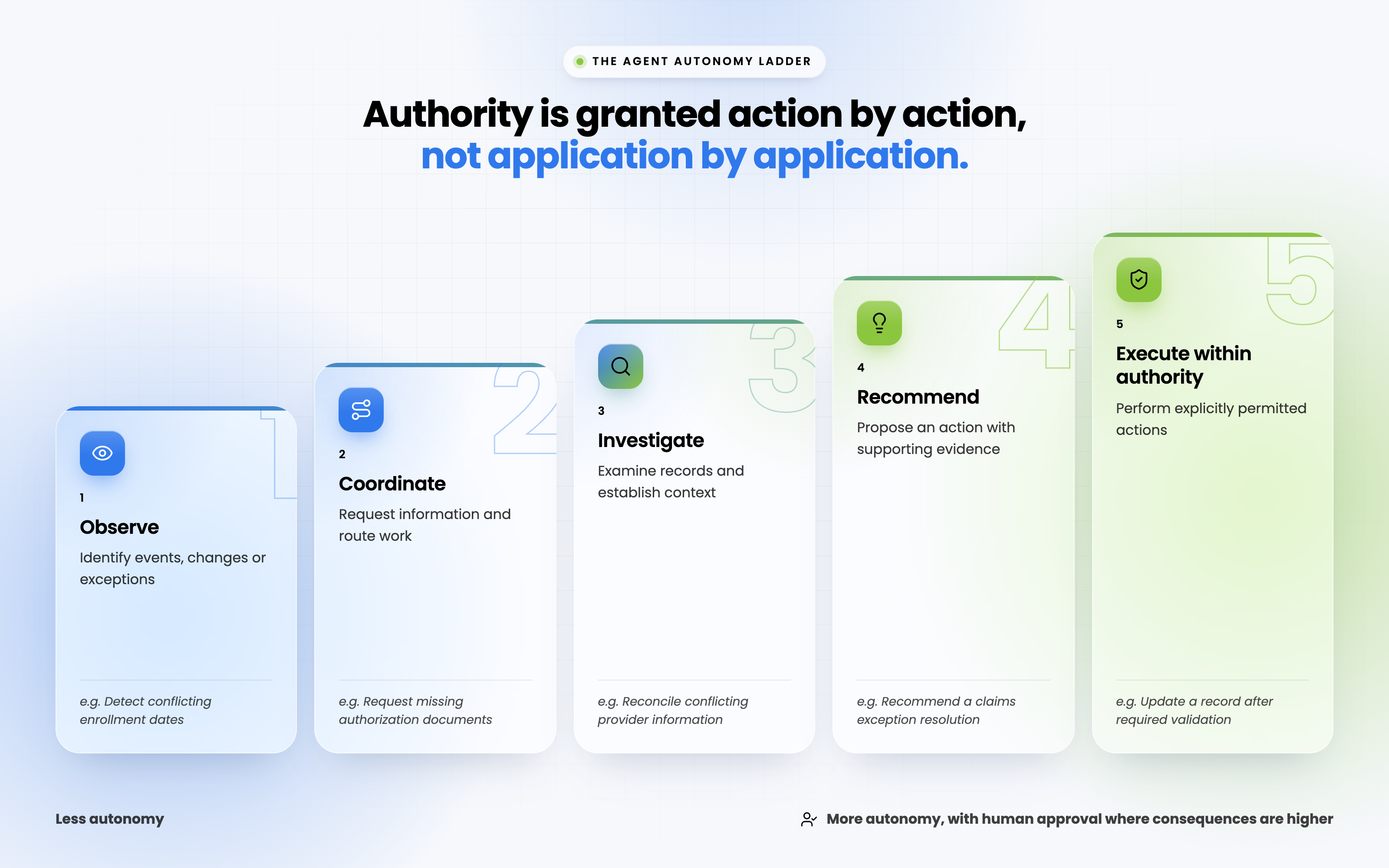
An agent capable of performing an action should not necessarily be permitted to act on it independently. The appropriate level of autonomy depends on the nature of the task, the sensitivity of the information, the possible consequences of an error, and whether an action can be undone or reversed.
One possible way to assess this is through a five-level framework.
| Level | Agent responsibility | Use case |
|---|---|---|
| Observe | Identify events, changes, or exceptions | Detect conflicting enrollment dates |
| Coordinate | Request information and route work | Request missing authorization documentation |
| Investigate | Examine records and establish context | Reconcile conflicting provider information |
| Recommend | Propose an action with supporting evidence | Recommend a claims exception resolution |
| Execute within authority | Perform explicitly permitted actions | Update an administrative record after required validation |
Compare requesting a missing document with issuing a coverage denial. Both involve deciding what happens next, but the consequences are very different. The first may suit automated execution under clearly defined rules. The second involves coverage criteria, regulatory obligations and a member's access to care.
Autonomy should therefore be set for individual actions, not assigned to a whole application. A sound governance model defines which systems an agent may access, which actions it may start, what evidence it must keep and when it must seek human approval. Any agent that touches protected health information also has to operate within HIPAA, including its minimum necessary standard. Frameworks such as the NIST AI Risk Management Framework give teams a shared vocabulary for risk. Reversibility matters too: a wrongly routed work item is easier to correct than an inaccurate payment or an adverse coverage determination. The goal is to give agents enough authority to improve operations without compromising member privacy, care delivery or accountability.
Why do agentic AI pilots struggle to scale?
An AI agent may perform well in a controlled demonstration because the required information is available, the workflow is clearly defined, and exceptions are limited. Unfortunately, payer environments cannot be controlled in such a clinical manner as they are wildly unpredictable and highly dynamic. A claim may depend on an enrollment change processed earlier that day. A provider record may contain conflicting or inaccurate information. A benefit rule has been updated, but the change may not yet be reflected across the system.
These conditions expose limitations that model capability alone cannot resolve. According to The GenAI Divide: State of AI in Business 2025 published by MIT under its NANDA Initiative, nearly 95% of AI pilots are unable to deliver the rapid revenue growth enterprises expect from them.
Four reasons explain why agentic AI pilots in healthcare operations are unable to scale:
Incomplete context
An agent cannot make a reliable recommendation if it lacks access to the information needed to interpret a transaction. For example, an enrollment discrepancy may appear straightforward until a retroactive eligibility adjustment changes the relevant coverage period. Without access to that history, the agent could suggest a correction based on an incomplete context.
Fragmented systems
Payer workflows typically span claims platforms, enrollment applications, provider databases, document repositories, and external portals. An agent that can retrieve information from one system but cannot verify or update the corresponding record elsewhere may leave a transaction only partially resolved. Integrations must therefore, depending on the workflow, accommodate permissions, transaction status, validation, and confirmation of completed actions.
Policy interpretation and operational exceptions
Policy guidelines and benefit matrices are rarely structured for programmatic interpretation. When an agent encounters ambiguous contract terms, it must calculate its confidence threshold and escalate the transaction for human review, rather than hallucinating an ungrounded resolution.
Insufficient governance and auditability
Production systems must establish what an agent was authorized to do, which information it can access and use, which actions it is allowed to perform, and whether those actions complied with the relevant rules and controls. This is especially important when several agents or automated services participate in the same workflow. Without a reliable record of those activities, operational teams may struggle to investigate errors, evaluate performance, or demonstrate accountability.
The lesson here is that successful deployment of agentic AI depends on the environment they operate in. For health plans, the biggest efficiency gains will be accrued when they can scale their AI projects and embed the technology in all of their workflows.
How should health plans measure agentic AI performance?
How many tasks a health plan has automated is an incomplete and insufficient measure of the value of agentic AI. An agent may complete several steps in the claims adjudication process quickly while also introducing an error that requires extensive correction downstream. On the other hand, another agent may automate fewer steps but resolve cases more accurately and reduce the need for repeated intervention.
For payers, performance measurement should reflect the quality and completeness of the administrative outcome. Some useful indicators could include:
| Metric | What it reveals |
|---|---|
| Correct completion rate | Percentage of eligible cases completed accurately |
| Exception resolution time | Time required to resolve administrative discrepancies |
| Human override rate | Frequency with which staff correct or reject agent actions |
| Rework rate | Additional processing caused by incomplete or incorrect actions |
| Cost per correctly completed transaction | Operational efficiency after accounting for quality |
| Audit and policy compliance | Whether actions follow established controls and retain adequate evidence |
If an AI system processes only straightforward cases and excludes complex exceptions, its straight-through processing (STP) rate will appear impressive but will not reflect its accuracy when handling exceptions. Payers should also evaluate error severity, escalation quality, and performance over time. An agent that recognizes uncertainty and escalates a case for human judgement with complete supporting context may be more valuable than one that delivers a misinformed resolution with confidence. Ultimately, the primary benchmark for agentic AI performance is to observe whether it improves administrative outcomes while maintaining the required standard of accuracy, control, and accountability.
What should health plans look for in an agentic AI platform?
Evaluating an agentic AI platform requires examining how intelligence interacts with existing administrative processes. Looking beyond a compelling demonstration of an AI agent answering questions or executing a predefined task, health plans should examine its five capabilities:
- Access to trusted transaction information. Buyers should ask how the AI agent handles conflicting records, historical changes, and source verification.
- Integration with existing workflows. The agentic platform should support interactions with the administrative systems where work actually occurs.
- Permissions and policy controls. Administrators should be able to determine which actions an agent can perform, under what conditions, and when approval is required.
- Human oversight and exception handling. The agentic AI workforce should recognize situations requiring escalation and provide reviewers with the information needed to make an informed decision.
- Traceability and continuous evaluation. Agent actions should produce records that allow organizations to examine what happened, assess compliance, investigate failures, and measure performance against operational objectives.
These criteria show why architecture matters. Unified operational platforms address the integration barrier by putting data, workflows and intelligence in one environment. HealthOS, HealthAxis's Enterprise Healthcare Operating System™, brings together four layers (Foundation, Operations, Intelligence and Experience) that connect administrative data, operational workflows, embedded intelligence in the form of Aipass™, and the interfaces stakeholders use to manage their work. The question for any plan adopting agentic AI is whether the intelligence can work with the administrative context, permissions and workflows needed for reliable execution.
What's next for agentic AI in healthcare administration?
Agentic AI is widening the scope for health plans to intelligently automate, coordinate, investigate, and even execute administrative operations. Its adoption, however, will depend on more than improvements in model-based reasoning. Health plans must determine which responsibilities can be delegated, how agents will interact with existing systems, and how their decisions and actions will be verified. These questions become more important as AI moves from supporting individual employees to participating directly in operational workflows. More pertinently, these considerations have to be acted on with the utmost seriousness because the ultimate goal of optimizing operations and resources by a healthcare organization is to deliver efficient and effective care to those who need it the most.
The most sustainable implementations will likely begin with well-defined administrative problems, measurable outcomes, and clearly bounded authority. Greater autonomy can follow where reliability, governance, and operational evidence justify it.
For payers, the opportunity in 2027 is to establish where agentic AI can deliver dependable value today while building the systems and controls required for broader adoption.
Frequently Asked Questions
Agentic AI in payer operations refers to AI systems that coordinate multiple administrative steps toward a defined objective. Depending on their permissions and integrations, agents may retrieve information, investigate exceptions, recommend actions and execute authorized workflow tasks.
Agentic AI in healthcare is AI that can pursue a goal through a sequence of actions across connected systems, rather than only answering a prompt. In health plan administration it is used for claims, prior authorization, enrollment, provider data and payment integrity workflows, within set permissions and with human oversight.
Traditional automation follows predefined instructions, while agentic AI can select and coordinate actions as information and workflow conditions change. Agentic systems may also use traditional automation to execute validated steps.
Generative AI creates or interprets content, such as summarizing a policy document. Agentic AI uses capabilities like that to pursue a goal across several steps and systems, taking permitted actions or escalating for review.
Examples of agentic AI in insurance for health plans include investigating a claims exception by gathering records and preparing it for resolution, checking prior authorization documentation and requesting what is missing, reconciling enrollment and eligibility mismatches, cross-referencing provider data against registries, and assembling evidence for payment integrity reviews.
It supports the administrative side: checking that documentation is complete, requesting missing information, tracking request status and routing cases to the right reviewers. Medical-necessity decisions and denials stay with licensed clinicians, as laws such as California SB 1120 require.
AI agents can support claims and prior authorization workflows by gathering information, checking documentation and preparing recommendations. Whether an agent may execute a decision depends on applicable laws, contractual obligations, payer policies and the safeguards around that action. Consequential clinical and coverage determinations need especially careful oversight.
No AI is HIPAA compliant on its own. Compliance depends on how a system is deployed: limiting an agent's access to the minimum necessary protected health information, applying access controls, keeping audit records and having the right agreements in place with vendors.
Major barriers include fragmented administrative systems, inconsistent data, limited integration capabilities, unclear agent permissions and insufficient auditability. Reliable deployment also requires effective exception handling, performance evaluation and human oversight.
CMS-0057-F requires impacted payers to meet prior authorization decision timeframes (72 hours for expedited and seven calendar days for standard requests, for most payers) starting January 1, 2026, to give a specific denial reason, to report prior authorization metrics, and to implement Prior Authorization, Provider Access and Payer-to-Payer APIs by January 1, 2027.
Payers should assess access to trusted data, integration with existing workflows, granular permissions, human review capabilities, audit trails and measurable operational performance. Demonstrations should include realistic exceptions and failure scenarios, not only straightforward tasks.