Skip to content

Healthcare payment integrity vendors can look alike on a slide: the same words, such as AI, anomaly detection, and savings. The differences show up in how and when each one reviews a claim, and in what it can show you when a provider disputes the result. This guide gives health plan buyers 15 questions to ask before choosing, grouped by what they reveal, with what a strong answer sounds like. HealthAxis sells a payment integrity product, so the questions are written to apply to any vendor, including us.
How do you compare payment integrity vendors?
Compare payment integrity vendors on six things: when they review a claim, whether they can explain and defend a flag, how they handle false flags, how they are paid, how they connect to your systems and protect your data, and what proof they can show on your own claims. Most pitches cover the first and skip the rest.
| Area | What it reveals | Questions |
|---|---|---|
| Timing | Whether errors are stopped or chased | 1 to 3 |
| Explainability | Whether findings survive a dispute | 4 to 6 |
| False flags | How much good work the vendor creates for you | 7 to 9 |
| Pricing | Whether the vendor is rewarded for prevention | 10 and 11 |
| Integration and security | How much effort and risk you take on | 12 and 13 |
| Proof | Whether the claims hold up on your data | 14 and 15 |
Pre-payment review catches a claim before it is paid. Post-payment recovery audits and collects afterward. Many plans need both, so ask each vendor which it does and how the two connect. For the background, see our explanation of the payment integrity process.
When in the claim lifecycle does the vendor review the claim?
Timing decides whether a problem is corrected quietly or recovered later from a provider.
- Do you review claims before approval, after payment, or both? A strong answer names the stage in the claim flow when the review takes place and specifies what happens to a held claim. A weak one says “we review every claim” and stops.
- Does your review read the same record as our claims system, or a copy? A copy can be out of date, and the reviewer may not see the claim as the processor did.
- How long does a held claim wait, and how do you meet prompt-payment deadlines? Ask for the turnaround you commit to and how held claims are prioritized.
Can the vendor explain and defend every flag?
A recovery you cannot defend to a provider or a regulator becomes a liability.
- Can a reviewer see why a claim was flagged? A strong answer shows the pattern and comparison data next to the flag. A score with no reason or context is a weak one.
- What evidence goes to a provider who disputes the result? Look for the claim lines, the rule, or pattern, and the policy behind it.
- Is every flag, review, and decision logged, and can we export the log for an audit?
How does the vendor handle false flags?
Every false flag slows a clean claim and costs a reviewer time.
- How do you define and measure a false flag, and what do you see in claims like ours? Ask for the definition first. A number without one cannot be compared.
- How do reviewer decisions feed back into the rules and scoring?
- Who can change or turn off a rule, and how fast?
How are payment integrity companies paid, and does it reward prevention?
- What is your pricing basis: a share of recoveries, a fixed fee, a per-claim fee or a software licence?
- If you are paid on recoveries, what is your approach toward saving money before a claim is paid? A fee based only on recoveries can reward chasing over prevention.
How does the vendor connect to your systems and protect your data?
- How do you receive and return data? Common routes are EDI 837 claim files, EDI 835 payment files, HL7 FHIR APIs, and flat files. Ask which ones are live today.
- Which security reports can you share, such as SOC 2 Type II and HITRUST, and who else handles protected health information (PHI)? Ask for the report itself, and for the business associate agreement.
What proof should healthcare payment integrity companies show?
- Can you run a pilot on our own claims before we sign? A strong answer sets the scope and the success measures up front.
- How do you count savings, and can we speak to a plan like ours? Ask them to separate money prevented, money recovered, and money “avoided”, and to clarify how each is checked.
What should you do after the demos?
- Give every shortlisted vendor the same set of your own claims, with a mix of clean claims and known errors.
- Score each vendor against the same 15 questions.
- Check references and read the security reports.
- Pilot before you sign, with measures agreed in advance.
Where does HealthOS Payment Integrity fit?
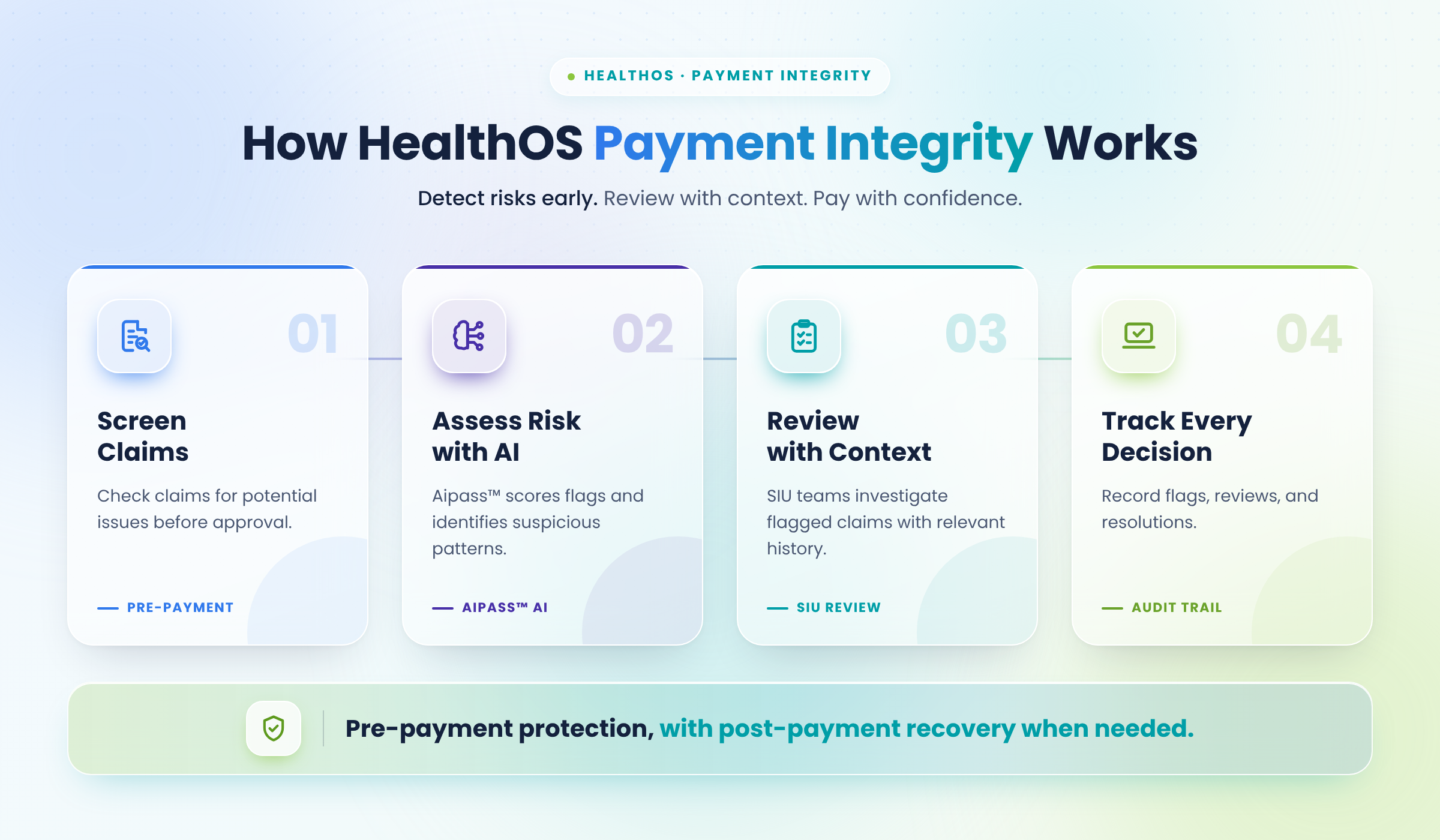
Here is how HealthOS Payment Integrity answers the first questions, so you can compare us on the same terms. It screens claims before approval, on the same record as HealthOS CAPS. Aipass™ scores each flag and shows the pattern behind it, Special Investigations Unit (SIU) reviewers receive the claim with its history attached, and every flag, review, and resolution is logged. Post-payment recovery stays available for anything the pre-payment review misses. For product detail, see our payment integrity solutions page. For wider context, read our guide to payment integrity in healthcare and our overview of claims adjudication.
Frequently asked questions
They review claims for errors, overpayments, and abuse. Some review before payment, some audit and recover after payment, and some do both. Some sell software and others sell services.
Compare vendors on when they review a claim, whether they can explain and defend a flag, how they handle false flags, how they are paid, how they connect to your systems, and what they can prove on your own claims. Run a pilot before you sign.
Common models are a share of recovered money, a fixed fee, a per-claim fee, or a software licence. Ask whether the pricing rewards stopping a bad claim before payment as well as recovering money after it.
Pre-payment vendors check a claim before it is paid and correct it first. Post-payment vendors audit claims after payment and recover overpayments. Most health plans use both.
The claim types and lines of business in scope, when in the claim flow review happens, how flags are explained and logged, how false flags are measured, the pricing basis, how data moves, the security reports required, and a pilot on your own claims.
Results from a pilot on your own claims, a clear definition of how savings are counted, references from similar plans, and current security reports such as SOC 2 Type II and HITRUST.
See how HealthOS Payment Integrity answers these questions
Bring your own questions to a demo and compare us on the same terms.
Request a Demo