Skip to content

A medical claim can pass auto-adjudication and still contain a payment error. A duplicate charge, an incorrect billing code, or an unusual reimbursement pattern may only surface after the payment has been released. At this point, the health plan faces a different problem. Instead of correcting the claim before payment, it must investigate the discrepancy, coordinate with the provider, and attempt to recover the overpayment. A stronger payment integrity process moves that work upstream.
Healthcare payment integrity aims to identify and address these errors before they become economic losses. By introducing claims payment integrity checks earlier in the claims lifecycle, health plans can detect questionable payments, prioritize reviews, and reduce their dependence on costly retrospective recovery.
This guide explains where payment leakage occurs, how pre-payment review works, and how AI-powered payment integrity solutions can help health plans make more accurate payment decisions.
What is healthcare payment integrity?
Healthcare payment integrity is the process of ensuring that medical claims are paid accurately in strict accordance with applicable coverage rules, coding standards, billing requirements, provider contracts, and reimbursement policies. An effective payment integrity strategy ensures that health plans identify improper payments caused by billing errors, duplicate claims, coding discrepancies, and fraud, waste, and abuse (FWA) activities.
The payment integrity process typically involves two complementary approaches:
- Pre-payment review: Identifying and resolving potential payment errors before funds are released.
- Post-payment review: Auditing paid claims, investigating discrepancies, and recovering confirmed overpayments.
The entire claims adjudication process is designed to determine whether and how a claim should be paid under applicable rules. Payment integrity is a critical stage in this process to identify errors and unusual patterns that routine reviews may not detect.
The objective is to pay valid claims instantly while preventing improper payments.
Where does payment leakage occur in medical claims?
Payment leakage occurs when a health plan either pays more than the claim requires, pays a claim incorrectly, or releases a payment that does not meet medical necessity. These errors most commonly originate in billing, coding, contract interpretation, or fragmented claims processing.
| Payment risk | What can go wrong |
|---|---|
| Duplicate billing | The same service is billed and paid more than once. |
| Unbundling | Services that should be billed together are submitted separately. |
| Coding discrepancies | Procedure or diagnosis codes conflict with applicable billing rules. |
| Provider billing outliers | Billing patterns differ significantly from comparable providers or historical baselines. |
| Contract discrepancies | Reimbursement does not match applicable contractual terms. |
Not every unusual claim is incorrect or fraudulent. A provider may have a legitimate reason for billing differently, and a flagged claim may still be payable, after undergoing thorough rechecks upon review. The challenge is distinguishing genuine payment risks from legitimate variation before payment is authorized.
When these discrepancies go unnoticed by reviewers, health plans face overpayments, recovery expenses, additional administrative work, and provider disputes.
The scale is visible in government data. The CMS FY 2025 Improper Payments fact sheet reports a Medicare Fee-for-Service improper payment rate of 6.55%, or $28.83 billion. Many of these improper payments are not necessarily fraud, and many come from documentation or coding problems that could have been caught pre-payment.
Why is post-payment recovery alone not enough?
Post-payment recovery strategies, also called healthcare overpayment recovery, seek to recover improper payments after the health plan has already disbursed the money. The recovery process usually involves identifying the discrepancy, reviewing historical claims, confirming the overpayment, notifying the provider, resolving disputes, and collecting the funds.
Whether the recovery exercise succeeds or not, it consumes a considerable amount of administrative and financial resources of the health plan, resulting in significant economic losses costing more to recover than the claim is worth.
Pre-payment review supports payment integrity before the funds leave the health plan.
| Pre-payment review | Post-payment recovery |
|---|---|
| Screens claims before payment | Audits claims after payment |
| Identifies potential errors before funds are released | Identifies errors in completed payments |
| Routes exceptions for investigation | Initiates recovery investigations |
| Helps prevent confirmed improper payments | Attempts to recover confirmed overpayments |
| Reduces avoidable recovery activity | Addresses errors missed by earlier controls |
Both approaches remain important. Pre-payment screening cannot identify every issue, particularly when relevant information becomes available later. However, relying primarily on recovery means accepting that preventable errors may be discovered only after payment.
The more payment risks a health plan can resolve before payment, the fewer avoidable incorrect payments it needs to pursue afterward.
How does pre-payment review prevent improper payments?
Pre-payment claims review introduces payment integrity checks before a medical claim is approved for payment. The review process typically involves five steps:
- Screen claims: Evaluate incoming claims against applicable payment rules, historical information, and billing patterns.
- Detect discrepancies: Use claims anomaly detection to identify duplicate charges, coding inconsistencies, unusual reimbursement amounts, and other potential payment risks.
- Prioritize exceptions: Distinguish claims requiring further investigation from those that can continue through routine processing.
- Review and resolve: Provide reviewers with relevant evidence to determine whether a claim should be approved, adjusted, or denied.
- Document decisions: Record findings, reviews, and resolutions to support auditability and future investigations.
A screening process that flags too many valid claims can create unnecessary delays and destroy auto-adjudication rates. Health plans therefore need payment integrity controls that identify meaningful risks without interrupting routine claims processing. For this, health plans can deploy AI-powered automated screening systems to identify surgically targeted discrepancies and direct higher-risk cases to the Special Investigation Unit (SIU).
What role does AI play in healthcare payment integrity?
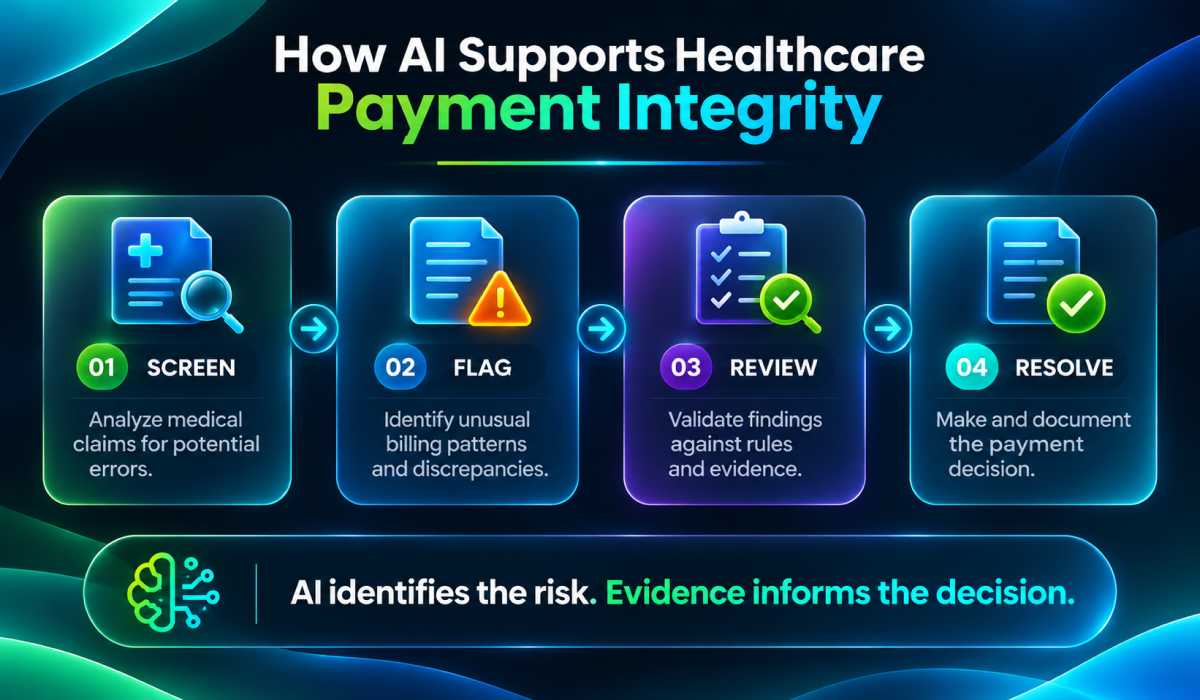
AI-powered payment integrity software can analyze large volumes of medical claims to identify discrepancies that may be difficult to detect through predefined rules alone. For example, AI can compare provider billing patterns, identify unusual claim combinations, detect potential duplicates, and prioritize claims based on their assessed financial risk. It can also help reviewers understand why a claim was flagged by presenting relevant patterns and supporting information.
However, an AI-generated risk score is not proof of an improper payment. Claims flagged for investigation still require appropriate validation against applicable billing rules, contractual requirements, and supporting evidence. When it comes to AI-powered claims reviews, explainability becomes central when a payment decision is questioned by a provider or examined during an audit. The operational value of AI is realized to its fullest when its findings are connected to claims data, reviewer workflows, and documented decisions, without creating another queue of alerts.
How can health plans improve payment integrity without slowing claims processing?
Effective healthcare payment integrity requires a balance between detecting improper payments and maintaining efficient claims administration.
Five operational practices can help a payment integrity system accomplish this:
1. Integrate screening into claims adjudication. Review payment risks with AI-powered intelligent automation using live claims information before payment authorization, reducing dependence on disconnected downstream vendors.
2. Prioritize meaningful exceptions. Use risk-based screening to direct potentially problematic claims toward investigation while allowing routine claims to proceed without disruption.
3. Give reviewers complete context. Provide access to claim history, relevant billing patterns, applicable rules, and supporting evidence to make investigations more efficient.
4. Track findings and decisions. Maintain records of flagged claims, potential FWA activities routed for investigation, reviewer actions, and final resolutions.
5. Measure prevention and recovery separately. Track confirmed improper payments that were prevented, incorrect payments that were recovered, false-positive rates, turnaround times, and administrative effort.
These controls, especially if powered by AI, can help health plans evaluate whether payment integrity improvements are reducing financial leakage without adding processing friction.
How does HealthOS Sentinel bring payment integrity into claims operations?
HealthOS Sentinel brings AI-powered payment integrity into the claims lifecycle, helping health plans identify potential payment errors before approval while retaining post-payment recovery capabilities. As the payment integrity workspace within HealthAxis’ Enterprise Healthcare Operating System™ (EHOS), Sentinel connects payment risk detection with claims operations and investigation workflows.
When used alongside HealthOS CAPS, Sentinel screens claims against the same adjudication record, reducing reliance on separate copies of claims information. Embedded Aipass™ intelligence evaluates potential risks, assigns scores to flagged claims, and presents the clinical and financial patterns behind those findings. Claims requiring further investigation can be routed to Special Investigations Unit (SIU) reviewers with relevant claim history and context attached. Each flag, review, and resolution is logged to support traceability and auditability.
Sentinel also supports post-payment recovery for discrepancies that earlier screening does not identify. For health plans operating existing core administration systems, Sentinel’s modular approach supports payment integrity modernization without requiring a complete replacement of the underlying claims platform.
The result is a more connected approach to healthcare payment integrity, where detection, investigation, and resolution become part of the claims operation rather than isolated activities.
Frequently asked questions
Pre-payment review identifies potential claim errors before payment authorization and disbursement. Post-payment review investigates claims after payment and supports recovery of confirmed incorrect payments. Health plans can use both approaches to reduce improper payments.
Health plans can combine automated claims screening, billing-rule validation, coding anomaly detection, risk-based exception routing, and documented reviewer decisions to identify and resolve payment errors before funds are released.
AI helps identify unusual billing patterns, potential duplicates, and other claim anomalies across large datasets. It can prioritize investigations and provide supporting context, while appropriate human oversight remains important for consequential payment decisions.
It can introduce delays when too many claims are falsely flagged or reviews are poorly managed across workflows. Risk-based screening, efficient exception routing, and clear review procedures can help limit unnecessary interruptions and protect auto-adjudication rates.
Some payment integrity solutions and services integrate with existing claims administration platforms. Integration capabilities vary, so health plans should confirm supported data exchanges, workflow connections, and deployment requirements.
Stop payment leakage before it becomes a recovery problem
Every improper payment identified after the fact presents an opportunity to improve how payment risks are detected earlier.
For health plans, the objective is not simply to recover more money. It is to make more accurate payment decisions, reduce avoidable administrative work, and maintain confidence across claims operations.
HealthOS Sentinel supports this shift by combining pre-payment screening, embedded Aipass™ intelligence, contextual investigations, and connected claims workflows.
Identify payment risks earlier. Resolve exceptions with greater clarity. Pay valid claims with confidence.
Request a DemoExplore how HealthOS Sentinel can help strengthen payment integrity across your claims operations.